The Definitive Guide to Knee Replacement Age Chart Timing
What Is a Knee Replacement Age Chart?
A knee replacement age chart is a clinical framework that maps out how surgical timing, patient age brackets, and joint degeneration intersect. It helps you and your surgeon evaluate when the lasting benefits of a new joint outweigh the risks of surgery or early implant wear.
For decades, many patients were told to wait until their late 60s or 70s before even considering surgery. Today, chronological age is no longer a rigid barrier to joint replacement. Instead, our board-certified surgeons evaluate functional disability (how much joint pain limits your daily walking, work, or hobbies), pain severity, and overall physical health.
National demographic data shows a noticeable shift: the average inpatient age for total knee replacement dropped from 68.9 years down to 66.2 years. Active adults are choosing not to live with years of debilitating discomfort when modern artificial joints can restore their mobility.
What Does a Knee Replacement Age Chart Reveal About Patient Outcomes?
Evaluating outcomes across age groups helps establish realistic expectations for pain relief, physical ability, and long-term joint survival.
Large-scale joint registries, including the National Joint Registry report on age at primary knee replacement by fixation, constraint and bearing type, provide clear insights into how different age brackets experience surgery and recovery:
| Age Bracket | Typical Goals & Indications | 15-Year Revision Risk | Average 1-Year Pain Score (Higher = Less Pain) | Direct Home Discharge Rate |
|---|---|---|---|---|
| Under 55 | Severe joint damage, trauma, post-traumatic arthritis | Elevated (~10–20%+) | ~76.3 | ~70–75% |
| 55–64 | Advanced arthritis affecting work and active sports | Moderate (~10.6%) | ~80.5 | ~65–70% |
| 65–74 | End-stage osteoarthritis limiting everyday mobility | Low (~5.2%) | ~84.2 | ~62–68% |
| 75 and Over | Severe pain interfering with basic walking and sleep | Very Low (<5%) | ~86.1 | ~54.1% (Women) / 69.8% (Men) |
Reviewing age-stratified data allows patients to discuss the age for knee replacement with their specialist, balancing immediate relief from chronic bone-on-bone pain against long-term implant durability.
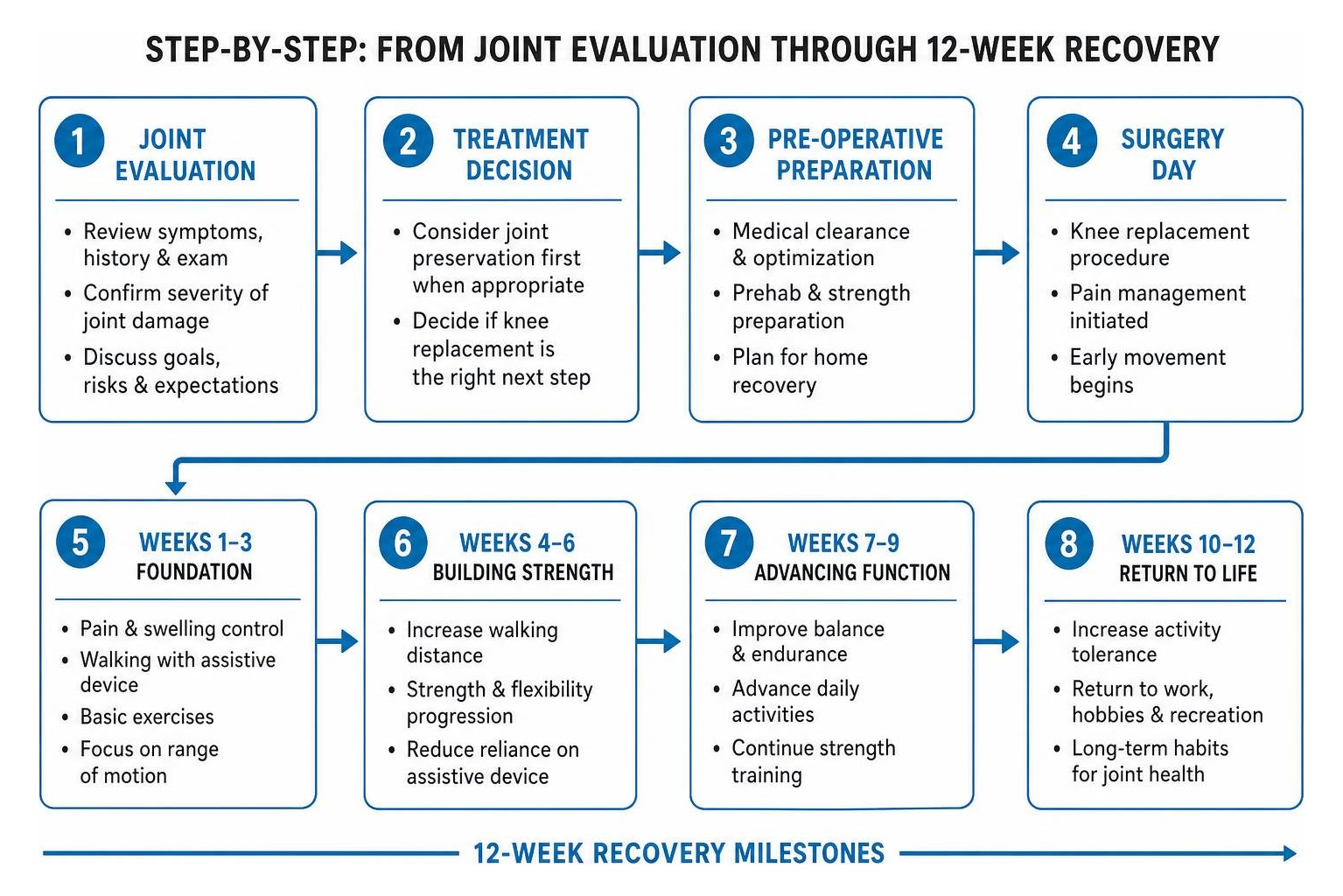
How Do Outcomes Differ for Younger Patients Under 55?
Patients under 55 who present for joint replacement often start with significantly lower baseline quality of life, daily function, and pain scores compared to older adults. Because they are often dealing with severe early-onset joint damage, post-traumatic arthritis, or inflammatory joint conditions, their baseline discomfort is severe.
Following surgery, younger patients experience dramatic improvements, often seeing the largest jump in overall pain relief scores (averaging a 36.8-point improvement from baseline to one year). However, studies analyzing registry data show their final absolute pain scores at one year (averaging 76.26) remain slightly lower than older cohorts (averaging 83.6).
Younger individuals also face a higher lifetime risk of revision surgery—up to two to five times higher than patients over 65. Because younger individuals participate in higher-impact activities and will rely on the prosthetic joint for 30 to 40 more years, the implant experiences increased mechanical stress. Clinical studies examining when risks of total knee arthroplasty overcome benefits in middle-aged adults emphasize that middle-aged patients (under 65) face roughly double the failure risk of seniors over 66.
For this reason, our specialists often evaluate joint-preserving alternatives first for younger adults, including physical therapy, targeted bracing, orthobiologic injections (such as platelet-rich plasma), and bone-realigning osteotomy procedures.
How Do Outcomes Differ for Senior Patients Aged 65 and Older?
Seniors aged 65 to 75+ consistently report high post-operative satisfaction and absolute pain relief scores, with patients 75 and older averaging pain scores above 86 out of 100 at one year. Their lifetime risk of needing a second operation drops significantly—down to approximately 5% for individuals undergoing surgery after age 70.
For patients in their late 70s and 80s, surgical planning shifts from worrying about artificial joint wear to managing overall medical health. Complications such as hospital readmissions, lung infections, temporary post-operative confusion, or heart and kidney stress require coordinated care and thorough medical clearance.
Post-surgical discharge patterns also vary by age and sex. National hospital data shows that 69.8% of men aged 45 and over are discharged directly home after surgery compared to 54.1% of women in the same age group, who more frequently utilize short-term rehabilitation facilities before heading home.
What Is the Optimal Age Window for Knee Replacement Surgery?
Large machine learning analyses of surgical cohorts have identified a specific optimal clinical window for joint replacement: between 63.5 and 73.5 years of age (centering in the early 70s).
Research using predictive models to explore the optimal age for total knee arthroplasty to minimize adverse outcomes indicates that this window represents the statistical “sweet spot.” Below age 63.5, the risk of needing a revision procedure within your lifetime is elevated; above age 73.5 to 76.5, hospital readmissions, longer recovery stays, and general medical complications begin to rise.
Comprehensive clinical literature reviews confirm this finding. A systematic review investigating whether there is an optimal age for total knee arthroplasty found that the early 70s provides excellent patient-reported relief with no significant increase in mortality or complication rates compared to younger groups. The review noted that every 10-year increase in patient age at the time of initial surgery reduces the risk of mechanical implant revision by 38%.
While statistical charts provide valuable population guidelines, your individual joint condition and lifestyle goals dictate your care plan. Reviewing our guide on understanding knee surgery types, benefits, and choosing the right option for you can help clarify whether total replacement, partial replacement, or non-surgical care fits your current stage of life.
How Do Implant Longevity and Revision Rates Change with Age?
Modern joint replacements are exceptionally durable. Under standard use, an artificial knee replacement has a 90% to 95% chance of lasting 10 years and an 80% to 85% chance of lasting 20 years. In our overview answering how long does knee replacement last?, we break down how prosthetic materials and surgical precision contribute to long-term joint survival.
However, lifetime revision risks differ dramatically based on how old you are when the joint is placed:
- Men aged 50–54: Face a lifetime revision risk of approximately 35%, largely because their active life expectancy outlasts the typical lifespan of the mechanical joint components.
- Women aged 50–54: Face a lifetime revision risk of approximately 20%.
- Patients aged 70 and older: Face a lifetime revision risk of only ~5%, as detailed in population studies analyzing the effect of patient age at intervention on risk of implant revision.
When an implant does require revision surgery, the primary causes across all demographics are aseptic loosening (loosening of the implant components from the bone without infection, accounting for roughly 40% to 49% of revisions) and deep joint infections (accounting for roughly 32.5% of revisions). For younger patients under 60, the average time to revision is roughly 4.5 years after the initial surgery, highlighting the importance of protecting the joint during high-demand physical tasks.
What Does the 12-Week Recovery Timeline Look Like After Surgery?
Recovery after knee replacement is an active, structured process. While patients in their 50s may rebuild muscle strength slightly faster than patients in their late 70s, both younger and older adults progress through the same functional recovery milestones.
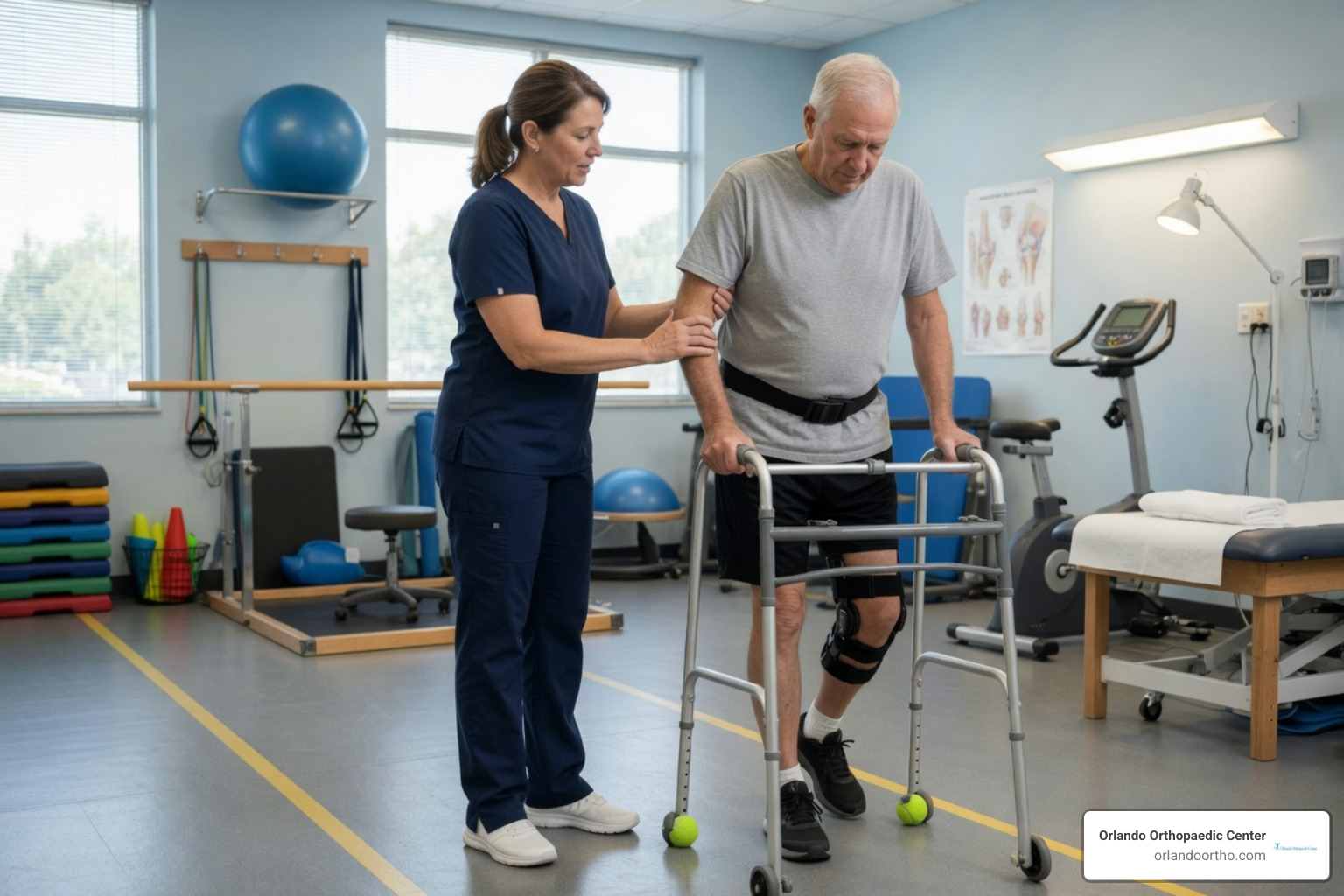
- Day 1: Rehabilitation begins within hours of surgery. Working alongside physical therapists, you will stand and take your first assisted steps using a walker.
- Weeks 1 to 3: You will work on regaining joint extension (straightening the leg completely) and reducing post-operative swelling. Most patients transition from a walker to a cane and begin walking independently around the house by weeks two to three.
- Weeks 4 to 6: Swelling continues to subside, and leg control improves. Most patients are cleared to drive (once off prescription narcotic medications and safe reaction time is established) and can return to desk jobs and light household tasks.
- Weeks 7 to 11: Physical therapy focuses on achieving 120 degrees of knee flexion (bending) and building quad and hip strength. Patients begin tackling stairs with greater confidence and walking longer distances outdoors.
- Week 12 and Beyond: Most patients can resume low-impact recreational activities, including golf, cycling, swimming, and doubles tennis. High-impact sports involving heavy jumping or sudden pivots (such as running, basketball, or singles squash) should be avoided to protect the joint.
Advances in surgical methods, including robotic-assisted joint replacement, have further streamlined early recovery. According to knee replacement statistics in US 2026, robotic-assisted procedures have expanded significantly in recent years, helping surgeons achieve highly accurate implant alignment tailored to each patient’s anatomy. Learn more about our specialized surgical approach to total knee replacement and customized rehabilitation protocols.
What Are the Most Frequently Asked Questions About Knee Replacement Timing?
Can a patient be too young or too old for a knee replacement?
Chronological age alone rarely disqualifies a patient from surgery. For patients under 50, surgeons generally exhaust non-surgical treatments and joint preservation options first due to the higher lifetime risk of revision surgery. However, if severe joint destruction, trauma, or inflammatory arthritis prevents basic daily function, joint replacement is an appropriate solution. For patients over 80, surgery is routinely performed with great success, provided cardiovascular, pulmonary, and metabolic health are cleared by a medical team.
Why do women undergo total knee replacement at higher rates than men?
Women experience higher lifetime rates of knee osteoarthritis (approximately 47% lifetime risk compared to 40% for men). This difference is driven by anatomical factors, pelvic alignment, differences in knee joint kinematics, and hormonal changes following menopause that affect cartilage health. In national registries, women account for roughly 62.7% of all knee replacement recipients in the United States.
How do I know if it is time to get a knee replacement instead of waiting?
Surgery is typically recommended when conservative measures—such as physical therapy, anti-inflammatory medications, weight management, and joint injections—no longer provide relief. Warning signs that conservative care is no longer sufficient include severe joint pain that wakes you up at night, joint stiffness that prevents you from putting on shoes or walking short distances, progressive bowing or knocking of the knee, and having to give up daily activities. For answers to common patient concerns, explore our knee replacement FAQs.
What Are the Final Takeaways for Planning Your Knee Replacement?
While age charts and national registries highlight the early 70s as the statistical sweet spot for joint replacement, your personal physical symptoms, functional limitations, and quality of life are the ultimate deciding factors. Living with chronic, debilitating knee pain is not an unavoidable part of aging, nor is it something younger, active adults must endure indefinitely.
Our specialized orthopaedic surgeons treat bones, joints, and soft tissue, offering comprehensive evaluations to determine whether joint preservation, partial knee replacement, or total joint replacement is best for your lifestyle and goals.
If knee pain is interfering with your daily walks, athletic goals, or time with family, schedule a consultation with our experienced team at Orlando Orthopaedic Center Total Knee Replacement Subspecialized Care or visit one of our walk-in clinics across Central Florida for prompt, expert care.